
Table of contents
TLDR
Over the years, web browsing and search have been revolutionized by user behaviors and Google’s evolutions. Today, it’s not just about ‘content is king,’ but also ‘experience is queen.’ Google’s ranking algorithm increasingly rewards pages and sites with the highest level of Web User Experience. What is the June 2021 Page Experience Update, and what are Core Web Vitals?
Read the article to learn more.
Introduction
In today’s world, we can define the web as a tool: useful, convenient, at your fingertips, but above all cost-effective. Amidst thousands of domains and millions of pages, however, internet users have less patience for slow and difficult-to-use websites.
That’s why usability is more important than ever. A user must be able to achieve their web search goal effectively and satisfactorily. Every online misstep leads to missed opportunities, especially in the digital business realm.
Google knows this well. It has always worked to enhance user experience and help users find the most relevant content. Recently, the search engine has undergone a paradigm shift—no longer just content, but also page user experience.
How the Web (and Google) Has Changed
To understand what’s happening today, it’s helpful to look at what happened yesterday.
Google was born as a search engine in 1998, and the first PageRank algorithm updates were designed and implemented in the early 2000s.
Many Google Updates between 2003 and 2021 aimed to improve user search understanding and the quality of content on webpages. Some notable updates include Google Boston, Florida, Panda, Hummingbird, and BERT.
However, it’s been since 2015 that Google began considering mobile web searches as the new standard for online navigation, introducing Mobile-First Indexing and Speed Update in 2018. Officially, that’s just three years ago!
It’s easy to see how mobile and tablet browsing has changed from desktop browsing, from content display to page interaction. Hence, Google’s focus has shifted more towards mobile-first usability.
Just a few years ago, predicting such changes would have been difficult, and the same might hold true for the years to come. However, what can be done is to understand what’s happening on Google today and take appropriate actions on one’s own website.
What is the Google Page Experience Update
With mobile-first indexing, Google’s algorithm has significantly evolved over time. Nowadays, it’s not just about providing users with the best content but also ensuring they can navigate webpages smoothly and without surprises.
Starting from mid-June 2021, Google introduced an update to assess page experience as a genuine ranking factor: the Page Experience Update.
A set of parameters related to performance, web usability, UX/UI, and accessibility have been introduced to measure how users interact with a page beyond its content.
Alongside other factors that constitute the page experience indicator, such as mobile optimization, the use of HTTPS, and the impact of interstitial ads on content accessibility, we now find the essential web signals known as Core Web Vitals.

What are Core Web Vitals
Core Web Vitals represent a set of metrics and indicators that measure the quality of the user experience on a webpage.
To calculate and optimize them, various tools offered by Google can be used:
from the report in Google Search Console to the Lighthouse dev tool in Chrome,
from websites like PageSpeed Insights and web.dev/measure to the Chrome UX Report and Web Vitals extensions.
Here are the three Core Web Vitals that effectively serve as Google ranking factors:
- Largest Contentful Paint (LCP): Measures page loading performance.
- First Input Delay (FID): Measures interaction time with the page.
- Cumulative Layout Shift (CLS): Measures visual page stability.

LCP: Largest Contentful Paint
The Largest Contentful Paint metric measures page loading performance.
Specifically, it indicates the loading time of the largest element, such as a multimedia file or a visible text block, while the page is loading for the first time.
This metric is focused on user perception and is essential for measuring perceived loading speed, as it indicates the specific point in time when the main content of the page should be fully loaded.
To provide a good page experience, the LCP score should be less than 2.5 seconds. Above 4 seconds, the user experience is considered poor.

FID: First Input Delay
The First Input Delay metric measures page interactivity time.
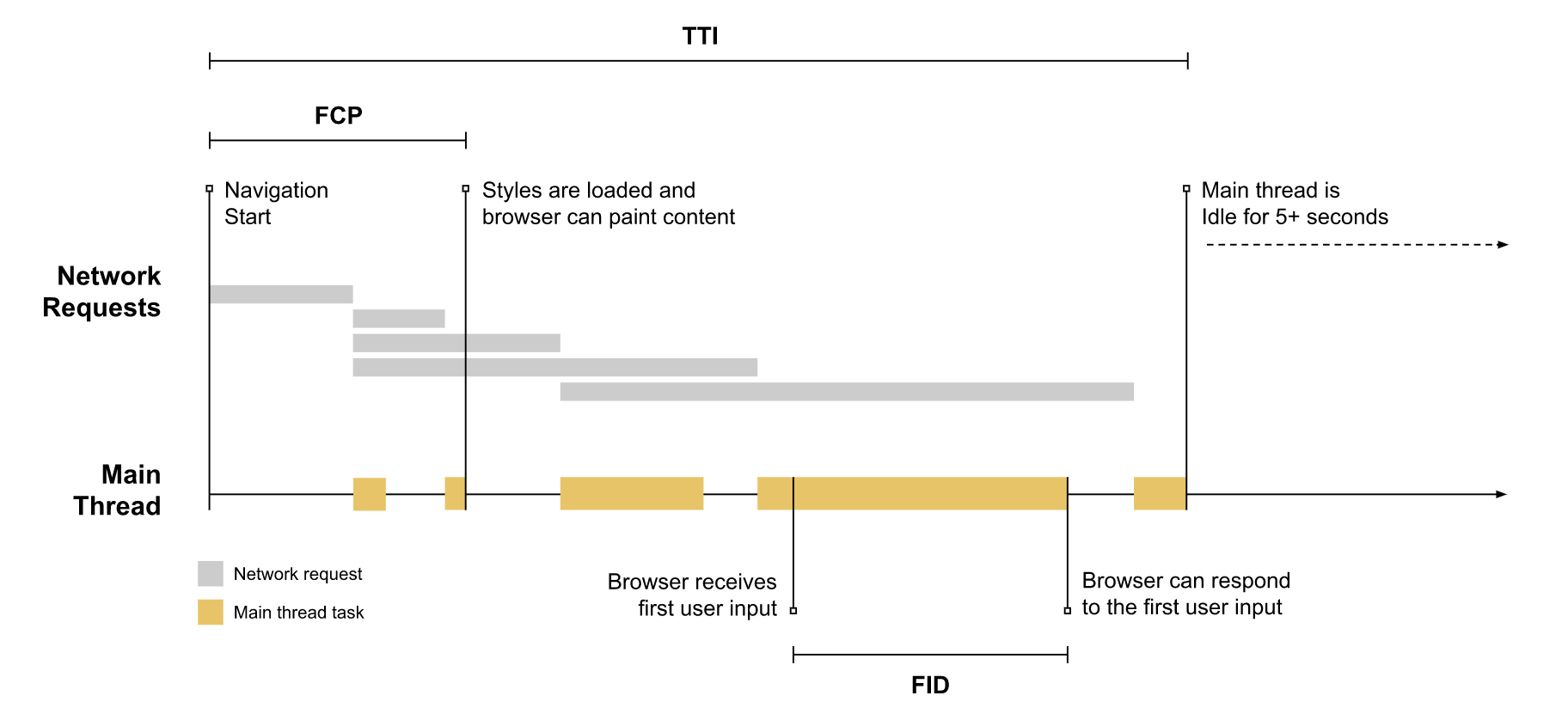
More precisely, it records the time between the user’s first interaction with the webpage and the browser’s response following the input. Interactivity is thus calculated based on the time the browser takes to respond to actions on the page.
This parameter also focuses on user perceptions: by analyzing the responsiveness of a webpage, it’s possible to understand when it’s difficult to interact with one or more elements of the page because they don’t respond to inputs quickly enough.
The optimal FID score for a good page experience is less than 100 milliseconds, while above 300 milliseconds, the user experience is considered poor.
CLS: Cumulative Layout Shift
The Cumulative Layout Shift indicator measures visual page stability.
In detail, it examines the movements of visible elements and sudden layout changes that cause a shift after loading an area of the webpage.
Unlike the other metrics, CLS doesn’t indicate a time interval. It was introduced recently due to the negative experience when an element suddenly moves on the page—be it an article’s text, an order confirmation button, or a download link.
On the CLS score scale, a good page experience value is less than 0.1. Above 0.25, the value is considered poor in evaluating the Page Experience.

Page Experience: Other Ranking Factors
Working to optimize page experience means considering a wide range of elements: some directly or indirectly affect page performance, while others influence Google’s ranking assessments.
Some parameters that can impact Core Web Vitals performance include:
- First Contentful Paint (FCP): The time interval from when the page starts loading to when the first element on the page becomes visible on the screen.
- Total Blocking Time (TBT): Measures the interval between FCP and TTI, which is the time the main thread remained blocked, preventing response to inputs on the page.
- Time to Interactive (TTI): The time between the start of page loading and the loading of key secondary resources capable of responding to user input.
- Speed Index (SI): The speed index calculates how quickly content becomes visible during page loading by analyzing visual progression in frames.
However, beyond Core Web Vitals, the quality of the Page Experience is also based on other elements that constitute the ranking indicator of page experience:
- The website must be mobile-friendly. As more people use mobile devices to access the internet, Google adapted its algorithm for this purpose in 2015.
- The page must be published in HTTPS. The protocol that guarantees secure and protected navigation has become a standard requirement for all internet users.
- Contents must be easily accessible. Elements too close together, too small or larger than the screen, intrusive pop-ups, and interstitial ads should be avoided.
In Conclusion
The web is an extremely dynamic and ever-evolving world—what seemed cutting-edge 3 or 4 years ago is now normal, expected, or even replaced. Similarly, user behaviors, needs, and habits also change.
That’s why, for a website to be functional, it cannot remain static over the years. In addition to careful initial design, periodic revision, updating, and renewal of the website are essential to maintain a high-quality User Experience.
If a website’s performance, such as loading speed, usability, positioning, and traffic, starts to deteriorate, it’s essential to determine whether these issues are easily and quickly solvable or require a complete site overhaul.
In both cases, the support of an SEO & Web Specialists team is vital for identifying and managing the issues behind a non-functional website, paving the way for a new mobile-first, responsive, and high-performing website.
Table of contents


