
Table of contents
TLTR
For the past few months, there has been a lot of talk about the latest iOS 14.5 update as something that would unpredictably and permanently revolutionize Social Advertising activities, particularly Facebook Ads.
But what is iOS 14.5, what effects is it having on Facebook Ads, and what will happen in the future? Let’s explore together.
What is iOS 14.5?
iOS 14.5 is the latest update for Apple’s mobile devices – iPhones and iPads – available to users since April 20, 2021. But what makes this update special? Why is it different from the others?
This update is different because, for the first time, it enables users to block the tracking of their actions within apps, including Facebook. These actions include page visits, views of specific products, items added to the cart, completed purchases, and many more. Everything done online is typically “recorded” by various apps: with the iOS 14.5 update for Apple mobile devices, this “recording” can be prevented.
But why does this matter to Facebook?
Facebook, like all social media platforms, relies on user preferences and tastes to provide its service.
How does Facebook learn about users’ preferences and tastes? By tracking what we do: the posts we “like,” the videos we watch, the products we comment on, and so on. With this information, Facebook can continue to offer us interesting content tailored to our preferences.
This applies to both organic (non-paid) content and paid advertisements: Facebook shows us sponsored content it believes is valuable to us based on our previous behaviors.
How iOS 14.5 Affects Facebook Ads
If the ability to track these behaviors diminishes, Facebook might face challenges in understanding which users to show the most interesting content to.
Facebook has therefore informed all advertisers that these changes would have unpredictable effects and has provided suggestions on how to avoid negative consequences in ad results.
Some of the consequences include:
- Campaign performance monitoring is less precise because fewer conversions are attributed to ads. Conversions still occur, but they might be harder to track.
- User targeting is more difficult, especially remarketing. This could lead to fewer conversions, as the remarketing audience usually performs well.
Facebook’s Solution to the “Impact” of iOS 14.5
To shield itself from the massive impact of this event, Facebook has recommended that all advertisers use a new tracking system, Aggregate Events. Activating aggregate events requires website verification.
Unfortunately, these events, touted as a way to “solve” the problem, are nothing more than statistical projections of actual results. The true results are, effectively, lost as they are not tracked upstream.
These days, the first results from Aggregate Events are starting to arrive.
What’s Happening Now?
Just a few days ago, the real change occurred, with concrete effects on the Business Manager (the tool for managing Facebook Ads).
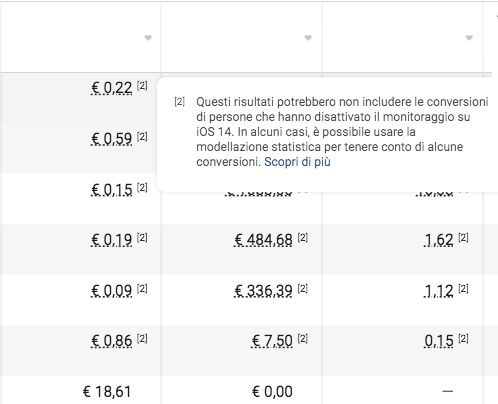
For instance, notes have appeared indicating that the results shown do not account for iOS 14.5 users who have opted out of being tracked.
How Many Users Are Rejecting Tracking?
According to the latest statistics conducted in the United States, currently, over 90% of users who have downloaded the iOS 14.5 update have rejected tracking.
Some advertisers are already experiencing a decline in the results of certain campaigns, especially those with more “complex” objectives, such as Purchases and Lead Generation.
Currently, this isn’t our case: the Facebook Ads campaigns we’re managing for our clients, which we monitor daily, haven’t experienced any decline so far.
If any significant performance drop occurs, we’ll inform the concerned client and work on optimizing the campaigns in this new Facebook Ads landscape.
Conclusions
Facebook is a constantly evolving and complex digital advertising tool. Those who work with it daily know that there’s usually something new to discover and adapt to at least once a week.
These changes are normal for us: they don’t scare us, and they motivate us to find new solutions to maintain high results for both ourselves and our clients.
Bring on the new challenges: if we hadn’t wanted to confront changes, we would have chosen a different profession :D
Table of contents


