Table of contents
Launching Google Ads campaigns targeting keywords closely related to your brand, such as your company name, tagline, or a distinctive product: does this practice make sense?
Intuitively, the answer might be no: in most cases, the top position in the SERPs for brand keywords is already occupied, without the need for any specific measures. Creating dedicated ads might seem like an expense and could even encourage users to click on the ad rather than the organic link, reducing its click-through rate and potentially impacting SEO. But then, how do we explain Microsoft’s and Apple’s ads for their brand keywords?
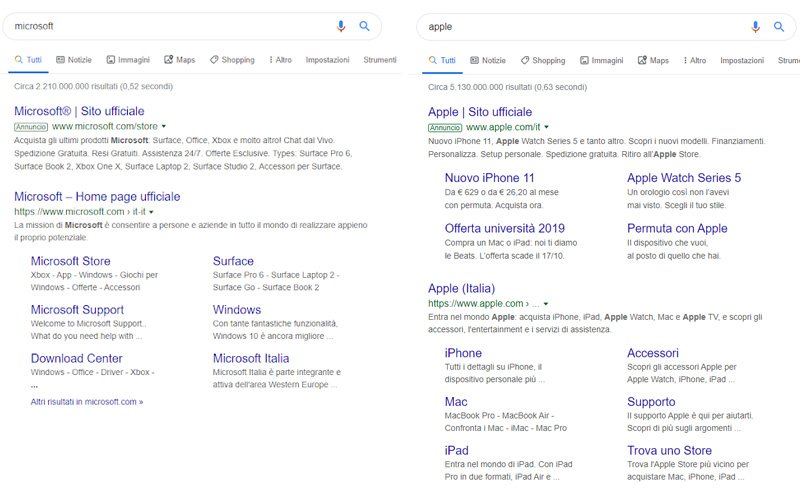
It’s hard to believe that the giants of the tech industry lack familiarity with online advertising to the extent of committing such a glaring mistake. Therefore, a further reflection is needed, which can arise from this tweet by Jason Fried (coding guru and CEO of Basecamp).
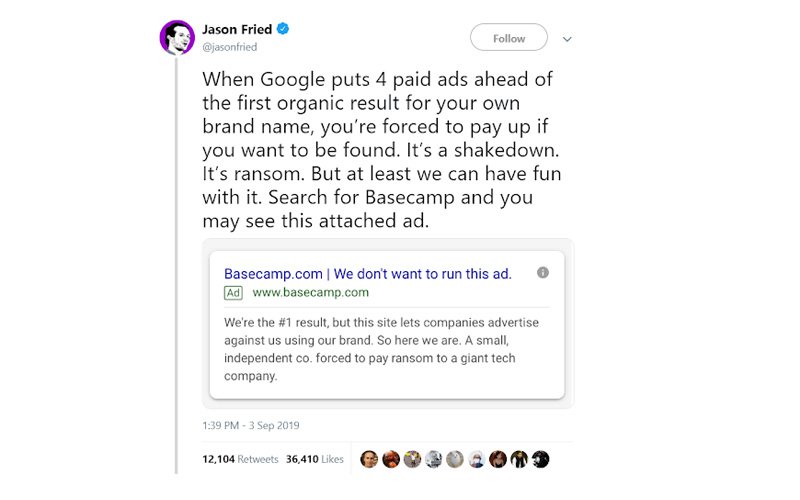
“When Google puts 4 paid ads ahead of the first organic result for your own brand name, you’re forced to pay up if you want to be found. It’s a shakedown. It’s ransom. But at least we can have fun with it. Search for Basecamp and you may see this attached ad.
Basecamp.com | We don’t want to run this ad.
We’re the #1 result, but this site lets companies advertise against us using our brand. So here we are. A small, independent co. forced to pay ransom to a giant tech company.”
Indeed, there are several reasons why setting up a Google Ads campaign around your brand keywords can be an effective – if not mandatory – strategy.
Protect Your Brand
Your competitors can use your brand against you by simply buying ad space on screens of those who search for you on Google. It’s true that the search engine provides a brand protection mechanism, which, when activated, blocks the use of certain brand keywords within the ad text. However, nothing prevents anyone from using your company name as a keyword, making their ad appear at the top of the SERP when someone was specifically searching for you.
In addition to aggressive commercial competitors, even affiliate companies or those with similar names, news organizations, and blogs might want to dominate the search results for your brand keywords. The only concrete way to prevent this is to place your ads in place of theirs.
Direct Traffic
Pages with the best SEO performance are rarely effective conversion platforms. When searching for a brand name, the company homepage is likely to be the first result and will capture most of the organic traffic, even though it’s several clicks away from the well-known “Buy Now” or “Contact Us” buttons. Much of that traffic will leave the site without producing significant interactions due to the convoluted navigation path. A paid ad doesn’t have these problems and can highlight pages that are more capable of generating conversions.
In this sense, Sitelink extensions of the ads are also very useful, allowing you to highlight different pages within the same ad. Sometimes, even an organic result can have this structure, but it depends on Google’s goodwill, as it decides whether and when to show the links and to which pages to refer them. In short, to direct traffic effectively, nothing can replace a sponsored ad.
Control the Message
To rank for brand-related keywords, a page will necessarily have to display those keywords in the Title and Description, as well as in the URL. The result displayed in the SERP will therefore be something like:
RANDOM STUFF
Random Stuff offers this, that, and the other. Discover Random Stuff!
www.randomstuff.com
There’s nothing wrong with this, but it’s an institutional and unchangeable message: writing the metadata of a page involves balancing SEO and CTR, necessarily sacrificing something on one side. Creating an ad, on the other hand, allows you to focus on the effectiveness of the claim and modify it as needed. The ad’s text can be tailored to the needs of specific target audiences, follow current trends, or simply showcase the brand’s creativity, knowing it will still be the first thing seen.
Occupy the SERP
The paid ad that appears in searches related to brand keywords won’t make organic results disappear; it will add to them, meaning the brand occupies twice the screen space for users. Since the second page of Google results is a dark and daunting place that few dare to venture into, occupying the first page means denying competitors a spot in the spotlight and gaining control over information related to your brand.
Improve Google Ads Performance
Google Ads assigns a quality score to each account based on the results obtained from its campaigns and the quality of individual ads. Now, obtaining an excellent rating by targeting your own brand keywords is quite easy: a user who has just searched for the company name is clearly inclined to click on the ad that advertises it. Each click obtained in this way signals to Google that the ad is well-designed, reducing the cost of subsequent clicks and increasing the overall quality score of the account. This, in turn, increases the effectiveness and cost-effectiveness of future campaigns.
In summary, pursuing your own brand keywords through Google Ads offers the opportunity to protect your brand from competition and misinformation, increase traffic, improve CTR, and strengthen your advertiser profile – all at a very low cost compared to other SEM campaigns.
Table of contents