Table of contents
TLTR
Microcopies within the web are those small phrases that guide the user in navigating a digital interface. By analogy, they are like road signs that guide the user as they travel through the web’s pathways.
Common examples of microcopies are button texts, CTAs (Call to Action), menu labels, form fields, and 404 pages.
The writing of these texts is highly valued and studied overseas, to the extent of creating a distinct field known as UX Writing.
To write effective microcopies, there are some useful guidelines that you can read below.
What is UX Writing?
Let’s start with the definition: User Experience Writing involves designing the small texts within digital interfaces that guide the user through navigation.
It’s not copywriting: UX Writers don’t write to persuade, magnify, or sell. Instead, they direct and guide users through the user journey.
When UX Writing is done well, it has significant commercial and branding implications.
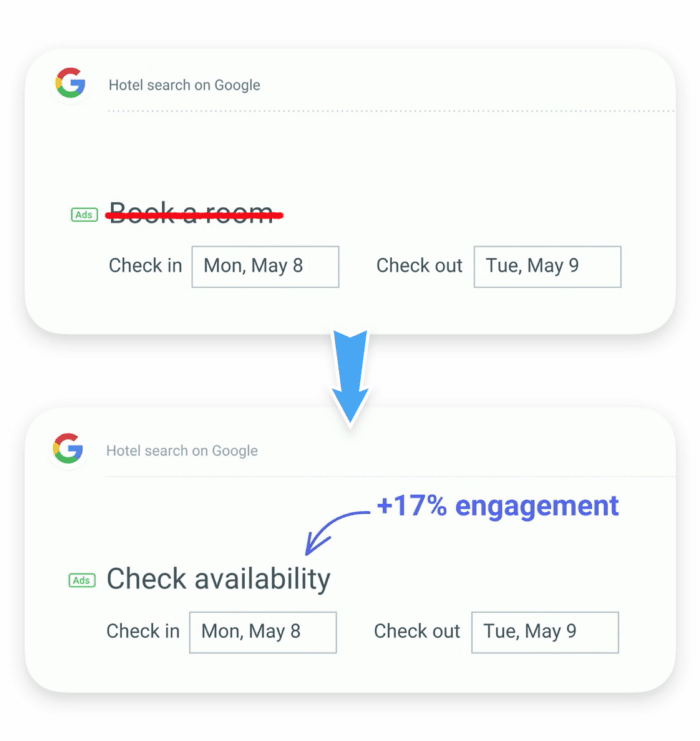
A famous example was reported by Google’s UX Writing team at the 2017 Google I/O conference: by changing the microcopy from “Book a room” to “Check Availability,” the search engine achieved a 17% increase in engagement rate!
How is it done?
To enhance the quality of microcopies, it’s helpful to follow a three-part process: project analysis, target analysis, and content design.
- Study the user journey, meaning the path the user takes within the site: which parts they read, where they click, where they go back, etc.
- Create a buyer persona, a profile representing the typical user: who are they? How old are they? What web experience do they have? What device do they use? etc.
- Design microcopies at specific points in the user journey and attempt to empathize with the user: at this point on the site, what information does the user need? How can I write it to achieve the objective?
Some rules for improvement
UX Writers have some general rules at their disposal that can assist them in designing these texts.
An excellent book that explains the subject well and provides valuable advice is “UX Writing, micro testi, macro impatti” by Serena Giust, from which some of the following rules are derived.
An UX Writer in their work should create texts that are:
- clear: using simple words and verbs, preferring the active form over the passive;
- with natural and informative language: avoiding technical terms, or if necessary, accompanying them with a simpler and more natural description;
- targeted and convincing: each microcopy must be functional within its context and convince through “tricks of the trade” (some of these “tricks” can be found in our article on what drives us to say yes);
- concise: paraphrasing Steve Krug from the usability book “Don’t Make Me Think!” unnecessary words should be omitted, and as Krug puts it, get rid of as many words as possible (Krug was more drastic and generally spoke of entire web pages: for the “third law of usability” he writes to eliminate half the words on each page and then get rid of half of those that remain).
There are no fixed rules, however, as UX Writing is not a science.
It’s important to bear in mind that technological advancement has made websites less cold and technical, but more human and emotional.
Therefore, the secret to good microcopies is to try to anticipate the user’s needs and attempt to satisfy them in advance, similar to the way Google’s search suggestions work when you mistype a word and it shows “did you mean…”
Conclusion
As part of a marketing strategy, a website can be optimized through careful design of microcopies that guide the user toward their goal.
If you’re interested in ensuring quality in this aspect within your web project, you can contact us via email at this address: web@antartika.it
Table of contents