Table of contents
Why is a website’s carbon footprint important?
In our article “Sustainable browsing: reducing your digital carbon footprint,” we discussed how accessing content on the internet, including that of websites, generates a massive amount of CO2 emissions into the atmosphere.
Every day, approximately 4.6 billion people use the Internet. According to a 2018 study by Nature, it is projected that by 2030, Internet usage will consume 21% of the world’s electricity, making the IT industry responsible for 5.5% of global emissions.

The explosion of web traffic, which increased by over 40% during the COVID-19 pandemic lockdown in 2020, highlights the urgent need for collective awareness of the environmental impact of our digital activities.
According to Deloitte, sustainability is a key concern for today’s consumers, with 50% of customers willing to pay more for ethical and environmentally conscious brands.
Having a carbon-neutral website is crucial in this regard: besides offsetting CO2 emissions, reducing a website’s carbon footprint helps stand out from the competition and improves corporate environmental responsibility.
Assessing a website’s carbon footprint is essential, as internet usage and online browsing have a direct impact on the climate. Making the digital world more sustainable is a vital part of the global fight against climate change.
How much CO2 does a website produce and how?
The carbon footprint of a website is measured by the energy it consumes. On average, a website produces 1.76g of CO2 per page view (source: Andrae ed Edler).
Accurately determining the energy needed to view a webpage is complex due to various factors. Should we consider the energy required by the server or also the energy needed to manufacture the server itself? Should we include the energy to build the user’s device or the ongoing maintenance and upgrades of telecom infrastructure?
Simplifying things, energy consumption for visiting a webpage can be influenced by factors such as:
1. Website hosting server
Hosting servers are housed in data centers, which have high energy consumption, often relying on fossil fuels. However, there is a positive trend toward the adoption of renewable energy sources by an increasing number of data centers, aiming to minimize carbon footprints. For website owners, it’s crucial to make informed hosting decisions: checking whether your hosting service operates sustainably is the first step.
2. Data transfer
Every website visit involves data traffic to and from the server, as per the client-server model described in our previous article. This process consumes significant energy across the telecom network, including energy used by data centers and network infrastructure.
3. Page weight and speed
The heavier a webpage is, the more energy is needed to transfer and display the requested content, leading to more emissions. A complex webpage with videos and high-resolution images, for example, requires more data traffic and thus more energy per visit.
On average, a webpage is considered heavy if it exceeds 2MB.
For a website with an average of 10,000 monthly page views, energy consumption results in an annual emission of 211kg of CO2, equivalent to:
- 1,055 km driven by car;
- 1.7 flights from Amsterdam to London (per passenger);
- 11 trees absorbing CO2 for an entire year.
A website has a low carbon footprint if its CO2 emissions do not exceed 0.5g per page view. Typically, most carbon footprint calculators use the following ranking:
| Rating / Evaluation | Grams of CO2 per page view |
|---|---|
| A+ | 0.095 |
| A | 0.186 |
| B | 0.341 |
| C | 0.493 |
| D | 0.656 |
| E | 0.846 |
| F | ≥ 0.847 |
Website carbon footprint calculators
Several online calculators allow easy and effective measurement of a website’s carbon footprint. To use these tools, simply enter a URL to receive a detailed report with practical tips for reducing the site’s carbon footprint.
A common feature of all carbon footprint calculators is their ability to highlight the sustainability of hosting services. They indicate whether the hosting provider uses renewable energy sources, offering website owners a valuable opportunity to better understand their site’s environmental impact and, if necessary, switch to greener hosting providers for a more sustainable future.
Let’s explore some of the leading website carbon footprint calculators:
This calculator helps companies quickly assess their website’s environmental impact, providing:
- the website’s emissions compared to the global average, graded from A+ to F;
- estimated CO2 emissions based on annual visits, compared with everyday examples;
- a badge to display on the website to showcase its carbon footprint.

This calculator offers a detailed breakdown of a website’s carbon footprint, comparing:
- the CO2 generated during the first visit versus a return visit;
- the page weight and data transferred during this timeframe.
This information is particularly useful for evaluating the efficiency of your hosting’s caching system. In this case, comparisons of monthly CO2 emissions are also provided with other common scenarios.

This tool provides a score (up to 100) divided into performance categories like user experience (UX), accessibility, and page weight, along with recommendations for further improvements.

How to reduce your website’s carbon footprint?
Now that we’ve identified the main contributors to a webpage’s CO2 emissions—hosting server, data transfer, page weight, and speed—let’s delve into what can be done to reduce a site’s CO2 emissions.
Opt for a Green Hosting
The first step website owners can take is to verify if their hosting is “green”, meaning the electricity used comes from clean energy sources.
Without using a carbon footprint calculator, you can check quickly whether a hosting provider operates sustainably through the Green Web Foundation website.
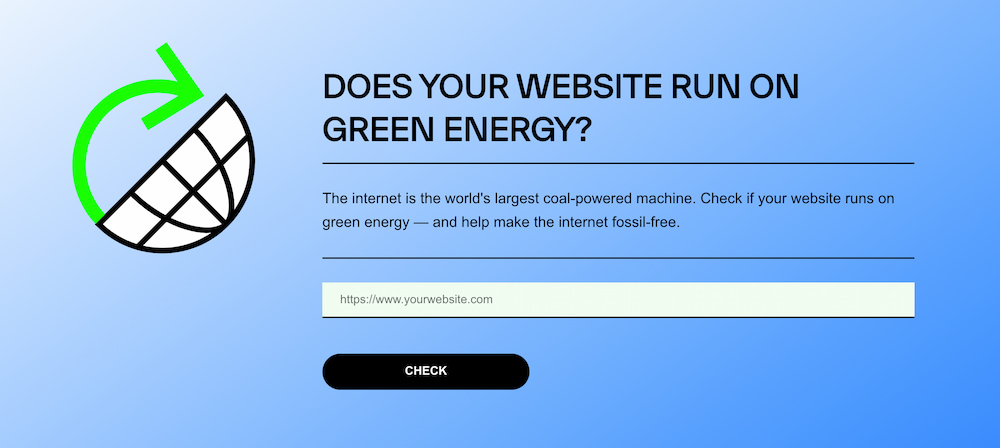
If your hosting is not green, try searching the keywords “green hosting provider in (your country)” and explore the list of results.
Use a CDN for data transfer
Sending and receiving data consumes a lot of energy; therefore, reducing distance likely lowers consumption. While we can’t predict where users will access our site from, we can “shorten distances” by using a Content Delivery Network (CDN).
A CDN is a group of servers distributed across multiple geographic areas, speeding up content delivery by bringing it closer to users’ locations.

Many hosting services already include a Content Delivery Network (CDN) in their offerings, improving website performance and content distribution on a global scale. If your current hosting provider does not offer this feature, you can easily integrate it through specialized external services like Cloudflare.
Here too, choosing a good hosting service plays a crucial role: if equipped with an advanced caching system, it can significantly reduce the amount of data that needs to be transferred. As seen with Digital Beacon, where we can calculate the differences between the first and subsequent visits, a hosting service with a good caching system saves mainly on the amount of data transferred during repeat visits.
Improve website weight and speed
If your website has been online for several years without any planned updates, you can likely reduce its weight with quick optimizations such as:
- Optimize ATF images: if an image weighs more than 1MB, especially in the hero area, it heavily impacts the page load. Compress it to a web-friendly format using tools like Squoosh.app.
- Choose next-gen image formats (WEBP, ATIF, etc.): this can be done through plugins or manually, using Squoosh.app.
- Replace the hero carousel with alternative content: carousels in the hero section often increase page weight.
- Avoid videos on webpages.
To discover additional ways to lighten your website, performance measurement tools like Google PageSpeed Insights can provide a detailed list of actions to take.
If you’re interested in creating a new website or redesigning an existing one, our advice is to approach it with a “sustainable web design” mindset to create a lightweight and high-performing site. This way, in addition to having a lower carbon footprint, the site will also benefit from improved SEO and UX: discover more reasons why having a fast website is important.
Use a web page screen saver
Some websites now include a feature that helps reduce their carbon footprint. If a web page remains open but unused for more than a minute, a screen saver is activated.
Like other devices that use screen savers, this feature reduces energy consumption by displaying a web page with a dark background to minimize the energy used by screen brightness. The screen saver also displays a clear message about energy savings and environmental impact.


Conclusion: towards more eco-friendly websites
As technology evolves and our world becomes increasingly digitalized, minimizing the environmental impact of the IT sector becomes ever more pressing.
The journey towards a greener web is a collective challenge that requires a joint effort from both users and website owners in making informed and conscious decisions.
By adopting sustainable practices, from choosing eco-friendly hosting to optimizing content, we can all contribute to reducing the carbon footprint of our websites. Together, we can make a difference, ensuring that technological progress goes hand-in-hand with environmental protection.
At this pivotal moment, the question is not whether we can afford to make our websites more sustainable but whether we can afford not to in the future.
At Antartika, our digital marketing agency, we can evaluate your website’s carbon footprint, identify areas for improvement, and implement strategies to reduce your online presence’s environmental impact and communicate in a green way.
Contact us to learn how to make your website more sustainable for the environment!
Table of contents