
Table of contents
What is a carbon footprint, and what is it for?
“A carbon footprint (or greenhouse gas footprint) is a calculated value or index that makes it possible to compare the total amount of greenhouse gases that an activity, product, company or country adds to the atmosphere. Carbon footprints are usually reported in tonnes of emissions (CO2-equivalent) per unit of comparison.”
Wikipedia
In simpler terms, a carbon footprint is an essential tool to understand how our daily actions—such as driving a car or using electricity—impact the environment through greenhouse gas emissions, the main culprits behind global warming and climate change.
Calculating the carbon footprint allows us to quantify the environmental impact of individual behaviors, companies, products, or entire countries in terms of tons of CO2-equivalent emissions released into the atmosphere.
This calculation serves as a starting point to identify areas where we can intervene, aiming to reduce our impact on climate change and protect the planet for future generations.
In this article, we won’t dive into the specifics of how the carbon footprint is calculated. Instead, we’ll focus on the carbon footprint generated by using the internet, exploring in depth the aspects to consider to minimize our digital carbon footprint and be more responsible and aware of our online activities.
The Digital Carbon Footprint of the Internet
“If the Internet was a country, it would be the 4th largest polluter.”
Sustainable Web Manifesto
The internet consumes an enormous amount of energy. But how is that possible?
To maintain and store the information available on the World Wide Web, massive databases, servers, storage facilities, and data centers are scattered around the world.
In other words, everything we use on our digital devices
- streaming videos,
- listening to music,
- interacting on social media,
- using email, chats, video calls,
- playing online games, and more
exists thanks to data centers, network connections, and the devices we own (which themselves were created with CO2 emissions).
Often, the electricity required to power the internet comes from fossil fuels, generating a significant amount of CO2 emissions. Globally, the carbon footprint of the internet amounts to a staggering 1.6 billion tons of greenhouse gases per year, roughly 3.7% of global emissions.
In the graph below, we can compare greenhouse gas emissions across various sectors.

However, many of the largest data centers are now powered by green energy. Over the last decade, this sector has become a major driver of renewable energy adoption. In 2020, tech giants like Amazon, Google, and Facebook were among the top ten purchasers of clean energy.
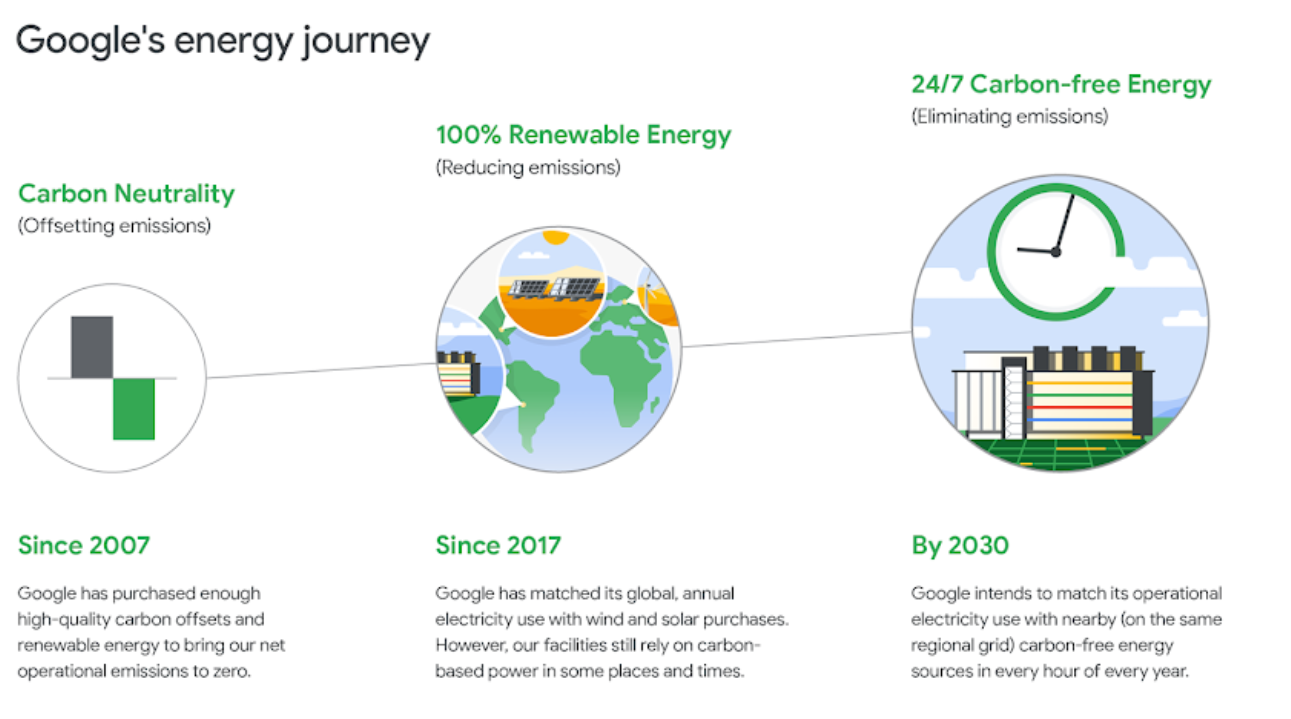
For instance, Google Cloud boasts several world-firsts:
- in 2007, it became the first major company to achieve carbon neutrality;
- in 2017, it was the first major global company to match its energy consumption with 100% renewable energy;
- by 2030, Google aims to use carbon-free energy across its entire global data center network.
The Carbon Footprint of Websites
To exist online, a website needs to be hosted on a server, known as hosting. This server is housed in data centers: hosting can literally be translated as “hosting server” since it provides the necessary infrastructure for a website to operate.
On the other side of the network connection, the user (or client) makes a request by typing the website’s address in the browser (e.g., www.antartika.it). This request is sent to Antartika’s hosting servers, which return the content of the website corresponding to the requested domain.
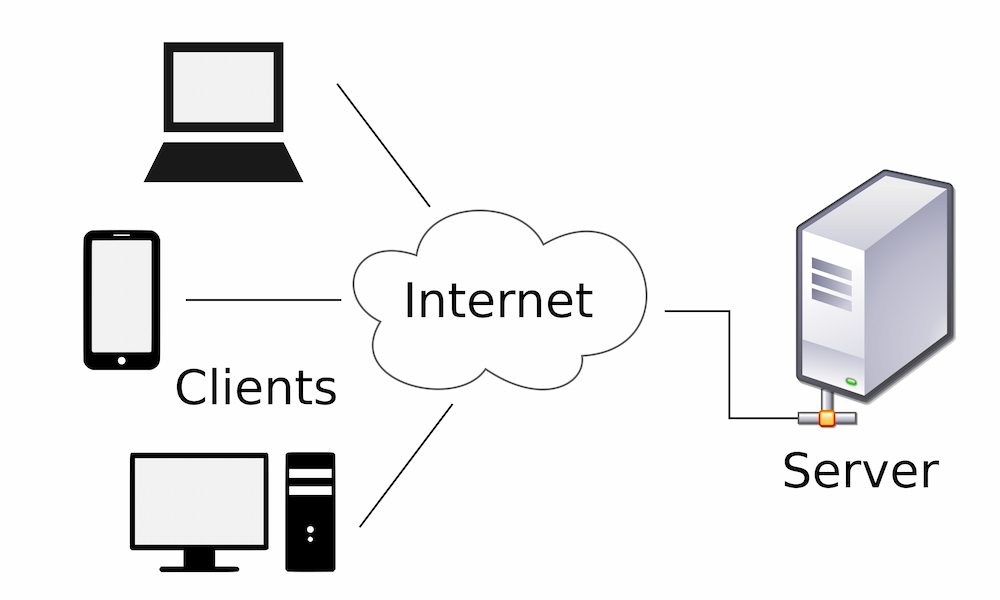
So, on one end, there are clients—us and our devices—requesting access to a website; on the other end, there’s a server that responds via the website, with the network in between facilitating communication.
Every website, therefore, has its own carbon footprint. This footprint can be optimized to reduce greenhouse gas emissions as much as possible. We discuss this further in the article: “Website Carbon Footprint: Why and How to Make Websites More Sustainable.”
Tips to Reduce Your Digital Carbon Footprint
We often forget, but every web search, every email sent or received, and every status update on social media consumes electricity and, consequently, produces greenhouse gas emissions.
To contribute to reducing emissions, considering what we’ve learned so far, the best advice would be to “go back to the roots.” However, it’s clear that we can’t go back to a time when the internet didn’t exist—it’s essential for countless daily activities.
Still, there are actions we can take to make a difference. Let’s create a practical, simple, and useful list of actions (not exhaustive) that anyone can implement daily.
Limit the exchange of emails
Have you ever received an email to which you would have replied with just “thanks”? In this case, it’s worth not responding—the message doesn’t contain essential information for the recipient. A thank-you is polite, but not in the digital world, where a thank-you can contribute to more pollution!
“If every adult in the UK sent one less “thank you” email, it could save 16,433 tonnes of carbon a year – the equivalent to taking 3,334 diesel cars off the road.”
Fonte: bbc.com
Limit email recipients
Be selective about the number of recipients in your emails, avoiding mass CC mailings.
Avoid sending attachments (when possible)
If you need to send an email with attachments that are available online (e.g., PDFs or images), share the link instead of downloading the files. This can significantly lighten the email’s load without omitting necessary information.

Carefully select your newsletters
Every email you receive adds to your carbon footprint: a newsletter with a single image produces about 50g of CO2. Unsubscribing from newsletters you don’t read will make a difference for the planet and your inbox.
Prefer messages over emails
Sending messages via chat (e.g., WhatsApp, Messenger, Telegram, Viber, and Slack) or SMS is less polluting than emails. A recent study shows that:
- Sending an email with a 1MB attachment to a single recipient emits 3.3g of CO2e.
- Sending a short, attachment-free message to 10 different recipients emits 4.9g of CO2e.
Save space on the cloud
Reduce cloud usage and favor storage on physical hard drives. Also, regularly clean up your online files as you do in your physical space.
Close browser windows and tabs
Limit the number of windows and tabs open in your browser, and close those you haven’t used for at least 10 minutes. You can always reopen them when needed.
Lower screen brightness
Reducing screen brightness from 100% to 70% can save up to 20% of the energy used, resulting in a significant carbon (and cost) saving.
Turn off unused devices
If you have a device in standby mode but aren’t using it, it’s better to turn it off entirely.
Delete inactive online accounts
Remove all online accounts you don’t use. They occupy space in a data center somewhere, whether they’re being used or not.
Reduce video calls or conferences
Turning off the camera during video calls significantly reduces greenhouse gas emissions. So, if possible, turn off the camera to reduce your carbon footprint—or better yet, opt for a phone call.
Be mindful of streaming services
Avoid streaming music or movies; instead, download files to local storage (your phone, computer, or tablet). In 2020, long-form video streaming accounted for about 45% of total internet traffic, generating 55g of CO2 per user per hour of streaming. Spotify confirms that user streaming represents 42% of the 353,000 tons of CO2 it produces annually.
Limit social media use
Reduce time spent on social media. According to Greenspector, greenhouse gas emissions from social media rank in this order:

Carbon footprint calculators developed specifically for social media are also available, such as the Social Carbon Footprint Calculator.
Choose online books and newspapers
Reading news or books online generates fewer greenhouse gases than the same content on paper.
Conclusion: Towards a Sustainable Digital Future
Throughout this article, we’ve explored the carbon footprint associated with internet usage, revealing the deep environmental impact of our digital behaviors.
While the internet’s infrastructure consumes massive amounts of energy and produces greenhouse gases, there are small, concrete steps we can take to reduce these emissions.
The shift toward renewable energy shows a growing commitment to sustainability, but the path to a carbon-neutral internet is still long. Responsibility lies not only with tech giants but with all of us.
Looking ahead, integrating sustainability into digital practices will no longer be just an ethical choice but a necessity. Awareness is the first step: knowing the carbon footprint of our online behaviors helps us make better decisions, not just for ourselves but for the planet.
At Antartika, our web marketing agency, we place great emphasis on digital sustainability for businesses: we offer solutions to reduce online environmental impact, from website optimization strategies to implementing more eco-friendly practices.
Contact us to find out how to become a greener company in the digital world!
Table of contents


